Week Ending 9/4/26
Even more poster art

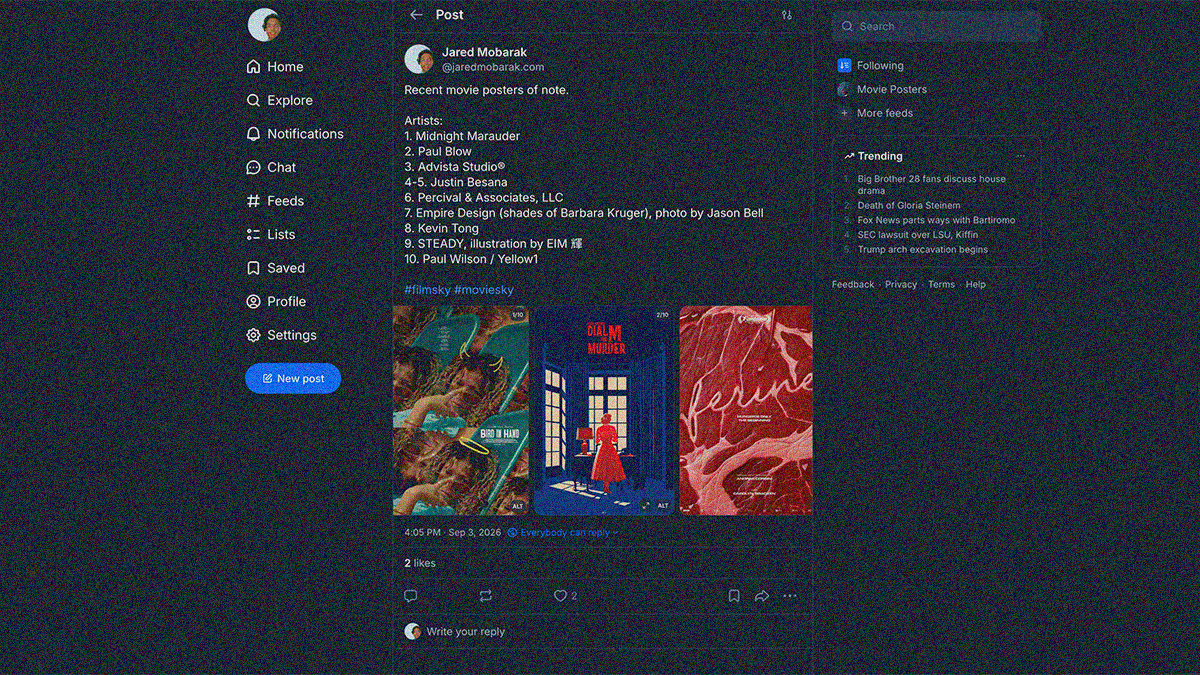
Inspired by a post from artist Jennifer Dionisio on Bluesky a couple weeks ago that lamented the fact so few cinematic institutions (studios, publicists, media, etc.) credit the artist of the movie poster or DVD cover they share, I recalled having a similar thought considering so many "Poster Premiere" emails hit my inbox with that same lack of credit. The newsworthy item being shared is literally the artwork and yet they don't think its artist is worth mentioning?
While I do my best to highlight film posters throughout the year with my long-running Posterized series at The Film Stage (the latest went up yesterday), I've made the conscious decision to limit myself to US calendar releases as a means of focusing the aperture on an otherwise infinite collection of potential candidates. That leaves a lot on the outside looking in whether it be films not distributed here or shorts few are able to see.
So, I started a weekly Bluesky post that highlights ten selections (only including those I can source an artist credit) from the past week. After a lot of designers left Twitter, they mostly migrated to Instagram rather than Bluesky as a means of self-promotion. And since neither Adrian Curry nor Jahan Singh Bakshi brought their curatorial accounts over, I figured it was worth filling the void myself.
I should probably hashtag them with a unifying link for easier access. Until then, here are the first three groupings: 8/19, 8/27, and 9/3.

Chronovisor

IN THEATERS (LIMITED)
_____
An academic researching the "historical theories of memory" stumbles upon the mention of an invention able to parse the visual and auditory wavelengths of memory. This "chronovisor" could therefore purportedly project any moment in history. You want to see Christ's crucifixion? How about an ancient Greek play thought to be lost forever? It would be the greatest scientific discovery in the history of mankind ... and, perhaps, the most dangerous.
Why? Because secrets would become a thing of the past. Governments with this power could simply watch their opponents as they plan an ambush. Citizens could turn the dial and see where their spouse was when they said they were somewhere else. It would dismantle the very concept of privacy and replace it with a perpetual paranoia. And yet, you must also wonder if the permanent transparency that results might also foster an era of pure equality.
Does Kevin Walker and Jack Auen's Chronovisor delve into these possibilities? Not really. Their film is less interested in the invention than the compulsive journey taken by Béatrice Courte (played by Anne-Laure Sellier, an actual polyglot scholar who serves as the Cartier-Chaired Professor of Behavioral Sciences at HEC Paris amongst other faculties to study "the area of time perception, creativity, and cognitive biases") to unearth its existence.
We are quite literally watching this woman get lost in a rabbit hole of research via a sort of forensic investigation into the unknown. Béatrice travels between NYC libraries to unearth a mix of publications and ephemera (most of which is authentic and discovered by the filmmakers themselves during a six-month trek across the internet) while also fabricating titles and awards to endear herself to people who might still have a connection to its inventor over the phone.
That elusive figure is Father Pellegrino Ernetti. While he wasn't alone in this discovery, he is the one most often caught speaking about the machine on the record. Yes, he never truly presented the necessary evidence to prove his declarations beyond a couple instances revealed as or presumed to be forgeries, but it's said that he was ordered not to be the Vatican itself. The Pope at the time chose protecting the technology over confirming the Bible's veracity.
So, most of what's on-screen are close-ups of these documents with highlighted text translated and superimposed atop the original printed material. It felt like I was back in college with my professors putting transparencies on the overhead and underling the pertinent information we should transfer into our notebooks. Gustav Holst's score helps invoke a sense of mystery and discovery onto these static screens, but it's still mainly a glorified lecture.
That doesn't, however, mean I wasn't caught up in the investigation. It's a lot of fun listening to Sellier's Béatrice alter her tact as she's passed from one contact to another. First, she's a professor of philosophy. Next a professor of musicology. Eventually a board member for a prestigious award. Anything that might get the person on the other end of the phone to bite and provide an address or number for acquaintances, family members, or Father Ernetti himself.
Chronovisor becomes a distillation of a psychological thriller wherein the suspense exists entirely in Béatrice's own mind. No one in the libraries watching her flip through pages would feel anything. Neither would the colleagues she meets for drinks and stale conversation that ultimately has her turning inward in thought as they drone on. Is this obsession hurting her actual research? Maybe. Does it matter if it leads her to the Holy Grail?
It's the kind of film that will surely find as many champions as detractors due to it being a cinematic representation of researching for your dissertation. As a formal work its objectively fascinating if for no other reason than how Auen and Walker make reading books into a kinetic experience. As entertainment, though, it can prove too dense and repetitive for some to stay locked in until the climactic aesthetic hypothetical of how the device might look.
I land somewhere in the middle. I won't deny I took a couple breaks to not risk falling completely into the latter camp, but I also won't deny that the chase had riveting moments. That's a testament to the filmmakers' use of archival material and the potential that this might be a fictionalized account of them actually solving the whereabouts of Ernetti's implausible miracle. We'd already know if it were true, though. So, pretend that it is and go along for the ride.
6/10
Come with Me
IN THEATERS (LIMITED) | VOD/DIGITAL HD
_____
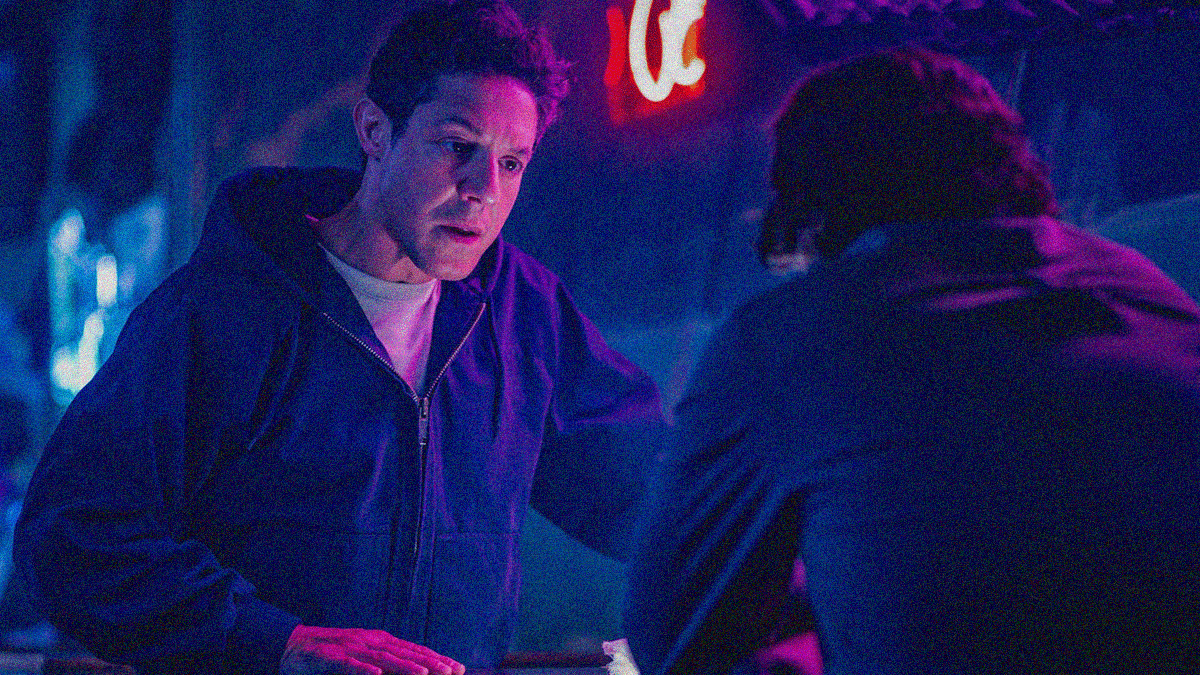
Simon Ward (Theo Rossi) is like many working class Americans who try to keep chugging along the path fed to them by societal pressures despite a world falling apart. He goes to work every day despite a confrontational boss (Michael Sirow's Dave) who wields his foreman power as his identity. He drinks a beer with his best friend (Ronnie Gene Blevins's Gary) to wind down. He goes home to relax on the couch with his longtime girlfriend (Kate French's Becca).
Should that be enough to survive the chaos stemming from an insane wealth disparity, partisan politics that have rendered debate impossible, and the paranoia resulting from a lack of ownership in your own life? No. But it's what we have. It gets us through the day. Most of us turn to hobbies to provide our happiness. Others lean on parenthood. Simon, unfortunately, gravitates towards talk radio with his shock jock of choice: Dalton Kirby (Ron Perlman).
Aaron Harvey's Come with Me, co-written with Jonathan Croom, could have been many things. Erroneously pitched as an "incel horror" despite Simon being in a committed relationship with someone who wants to have his children, I braced for Kirby's rhetoric to spew forth like Alex Jones (I'm sure Perlman, a staunch democrat, would have reveled in the opportunity). That's not the case, though. On the contrary. Some of what this character says makes sense.
And therein lies the danger at the film's heart. A lot of the troubles we ascribe to external forces are actually born from within. You can argue that the way Kirby orates is part of the issue since his cadence and demeanor plays like a cult leader riling his flock, but the words themselves could feasibly be weaponized by either side of the aisle. It's not a mistake that he's constantly prefacing with disclaimers and backtracking before he even gets to his point. He's playing both sides.
At one point we watch Simon engaging with Becca's co-workers at a BBQ in their backyard. The topic of Kirby comes up with the guests pointing to his inflammatory speech as "crazy" while their host walks up. We brace for the impact of what we assume will be a defense only for Simon to flip the interaction on its head by using Kirby's words in a way that makes them seem like an attack on him. It's possible because they're hollow until heard.
Harvey hasn't created a polemic against MAGA or "coastal elites." Just as Kirby vilifies both extremes as one villain wearing different clothes, Come with Me blurs the line to focus on their shared victim. How does someone like Simon fall prey to the charismatic evil from the right that tricks him into voting against his own self-interests? The same way the left tricks him into pretending its different despite fighting against the exact same progressive policies he craves.
In that respect, Kirby is correct. We do need to tear the system down. We do need to hold the one-percent accountable. But his lack of actionable ways to do so beyond simply fomenting fear and rage only exacerbates the problem. Why? Because it proves his agenda is the same as those politicians. He cares only about the ratings and clicks he hypocritically rails against to provide his own self-enrichment on the backs of the poor souls he indoctrinates.
One could therefore hail Simon as a hero. Yes, he's a troubled man who needs help. Yes, this is another case where therapy should probably be mandated for all men. But his confusion never usurps his humanity ... at least not fully. He feels the walls closing in with struggles at work. He worries that he's about to be the next victim of America's corrupt system after a break-in reminds him how renters are second-class citizens. He's susceptible to parasocial sympathies.
Simon watches the health care industry strip Gary of his humanity. He feels as though he's being silenced when he meets Becca's conversation about kids with an honest assessment of the world in which they'd be bringing that child into. He experiences the electric energy of holding a handgun for the first time and embraces its potential to shift the power dynamic he sees as always being stacked against him. So, we anticipate his inevitable break from reality.
But Harvey still relents. Rossi still leans into his character's humanity. Neither is interested in making Simon into a monster to be dismissed. They understand that his worth is in the complexity of the contradiction between his soft and caring heart and his tired and impressionable mind. He knows the people he's mad at aren't the real problem despite wanting to make an example of them. He knows "they" want him to turn on his neighbors instead of them.
Now I'm starting to sound like Kirby with his euphemistic pronouns letting his listeners fill in the blanks before tossing him a few bucks for the trouble. That's how "they" get you. That's how "they" turn decent men and women into unhinged lunatics who've lost the ability to modulate their real issues away from a constant scream of off-putting aggression. And it's how "they" create the very things "they" tell us to fear. It's a self-perpetuating profit cycle.
So, I cheered when the climactic gunshots blare because it felt earned. Does that make me any better than "them"? Probably not. Some of my enthusiasm is because sane viewers see the opportunism. Some is due to Harvey intentionally building the film to put us inside Simon's head, aligning us with his cause no matter how wrong his actions are. Reality soon prevails, though, to show spin is everything. One man's martyr will always be another man's pariah.
7/10

This week saw Regretting You (2025) added to the archive (cinematicfbombs.com).
Dave Franco dropping an f-bomb in REGRETTING YOU.

Opening Buffalo-area theaters 9/4/26 -
• Akira 4K Re-Release at North Park Theatre (select times); AMC Maple Ridge; Regal Galleria, Quaker
• American Doctor at Scene One Market Arcade
• Bethlehem Kutumba Unit at Regal Elmwood
• By Any Means at Dipson Flix, Capitol; Scene One Market Arcade; AMC Maple Ridge; Regal Elmwood, Transit, Galleria, Quaker
• Cars: 20th Anniversary at Dipson Flix, Capitol; Scene One Market Arcade; Regal Elmwood, Transit, Galleria, Quaker
• Dear You at Regal Transit
• Fall 2: Deadpoint at Dipson Flix, Capitol; Regal Elmwood, Transit, Galleria, Quaker
• Late Fame at Dipson Amherst
"Donovan and Lee expertly show the duality of artifice and vulnerability while Dafoe magnificently embodies the war between the safety of contentment and danger of joy." – Full thoughts at HHYS.
• Mirzapur: The Movie at Regal Elmwood
• Onslaught at Dipson Flix, Capitol; Scene One Market Arcade; AMC Maple Ridge; Regal Elmwood, Transit, Galleria, Quaker
• Romanchakam at Regal Elmwood
• The Salt Path at Regal Galleria, Quaker
• The Sun Never Sets at Regal Transit, Galleria, Quaker
"Fanning is at her very best. The joy. The rage. The uncertainty. The fear. Her sincere vulnerability is only bested by the courage to finally say enough is enough. Not to them, but to herself." – Full thoughts at HHYS.
• Tom and Jerry Forbidden Compass at Dipson Flix, Capitol; Regal Elmwood, Transit, Galleria, Quaker
• Virginia Woolf's Night & Day at Regal Quaker
Streaming from 9/4/26 -
• Erupcja (MUBI) – 9/4
"We have fun with the ladies. Suffer the disappointment of their significant others. And find solace in Nel and Rob’s mutual desire to keep orbiting Bethany despite the heat. Sometimes we become too mesmerized to remember to run." – Full thoughts at The Film Stage.
• Folktales (Netflix) – 9/4
• Fuze (HBO Max) – 9/4
"Every maneuver places us front of mind to surprise, reward, or confuse. It’s a highly addictive candy bar of a movie that should satisfy anyone’s sweet tooth." – Full thoughts at The Film Stage.
• Mayday (Apple TV) – 9/4
• Parasomnia (Shudder) – 9/4
• Signal One (Hulu) – 9/4
• Teenage Wasteland (Netflix) – 9/4
• Untold Mr. T: I Pity The Fool (Netflix) – 9/8
• Drawn Together (Prime) – 9/9
• Why Did I Get Married Again? (Netflix) – 9/9
• Call My Agent! The Movie (Netflix) – 9/10
Now on VOD/Digital HD -
• The Big Cheese (9/1)
• Confinement (9/1)
• I Want Your Sex (9/1)
"Hoffman is perfectly toeing the line between gullibility and trust just how Erika describes him. And Wilde is transfixing as the puppet master pulling his strings with a trickster gleam in her eye." – Full thoughts at HHYS.
• Just Play Dead (9/1)
• Nightborn (9/1)
"It’s a sort of hybrid that uses its conventions as a means for subversion. Yes, its superficial packaging can hurt it at times, but the undercurrent of non-conforming empowerment still shines through." – Full thoughts at HHYS.
• The Soccer Agent (9/1)
• Come with Me (9/4)
Thoughts are above.
• The Girl in the River (9/4)
• Maya & Samar (9/4)

Pieces from the Dancer in the Dark (2000) press kit.